Showing posts with label Mains. Show all posts

Sunday, 10 February 2019

Musaca de Cartofi

"Potato moussaka"

Moussaka is a fairly common dish over the Balkans with many different variations and using a variety of 'on-hand' ingredients. The dish is thought to have originated in the Middle East and spread throughout the region during the period of Ottoman rule. It's name suggests a dish that was continuously 'fed liquid' to keep it moist as it baked, although most common versions are more solid. Many Balkan versions spurn the eggplants so popularised by the well-known Greek version, and quite commonly have a top layer of cream solidified with egg. This version mixes the cream with the middle meat layer but its slow cooking results in a tasty and perhaps lighter-feelings dish with less stodge.

Time: 2 hours
Servings: 4 big slices or maybe 6 smaller ones.
Ingredients:

750g of potatoes, peeled and sliced
500g of minced meat (could be lamb, beef or pork or a mixture)
1 carrot, peeled and grated
2 onions, finely chopped
An egg
1/2 cup of 'smantana de gatit' (unsweetened cooking cream)
1/2 cup of white wine
1 cup of tomato bullion
1 level tablespoon of caster sugar
2 juicy ripe tomatoes
Salt, pepper and thyme
1/2 cup of soup stock (or half a beef stock cube dissolved in 1/2 cup of boiling water)
Oil for frying, butter for greasing dish, and some breadcrumbs or flour for dusting.

Method:

1. Pour a few millimetres of olive oil (traditionally you can use 'untura' (pig lard)) into a frying pan and brown off the potato rounds in batches on each side, removing them to a plate as the turn colour.
2. Gently fry the onion for a few minutes in the remaining oil and, once it has turned translucent and taken on a little colour, add the minced meat and the grated carrot and cook on a low-ish heat until the meat has changed colour.
3. Add the bullion, watered down a little if it seems too thick, and simmer the meat gently for about half an hour, being careful not to let it burn or stick (add a splash of water if and when needed), until a rich meat sauce, not too runny, remains. Allow to cool when done.
4. Meanwhile, grease a tray with butter or lard and sprinkle the sides and bottom with breadcrumbs ('pesmet') or flour.
5. Into the cooled meat sauce, mix in the egg and the cream and add salt, pepper and thyme to taste.
6. Place a layer of the potato slices in the bottom of the tray, then spread the meat sauce of top, followed by another layer of the remaining potato slices on top of the meat.
7. Thinly slice the ripe tomatoes and place them in a layer on top of the potatoes.
8. Pour the wine and stock over the top.
9. Put it in the oven on the relatively low heat and allow to cook for about an hour or until it starts browning off on top and most of the liquid has disappeared.

Monday, 5 December 2016

Sarmale in foi de varza

"Meat-stuffed cabbage rolls"

Although I haven’t posted many recipes recently, partly because most of the ones I know or like I’ve already posted, but also due to a lack of time and other project, I’ve always felt this blog is incomplete with having at least one recipe for sarmale (and perhaps another for cozonac). So, with Christmas coming up I figured it was time to have a go at them. Why not give them a try and make that Romanian in your life extremely happy!

Sarmale form a staple part of Romanian festive cuisine. These meat-stuffed cabbage rolls will almost certainly grace any seasonal feast, be it Christmas or Easter or even other celebrations, such as weddings, baptisms or birthdays. Their origin is most likely Turkish, ‘sarmak’ is the Turkish verb for ‘roll up’ after all, but over time they’ve been adapted to Romanian tastes with the addition of pork. They are relatively easy to make, although cooking takes some time (2-3 hours), but they can be made in advance, reheated (apparently making them taste better) or even frozen (so I’m told).

Time: 30 minutes for prep, then 2-3 in the oven with occasional checking
Servings: Makes about 20-25 sarmale (depending how big or small you make them), enough for 4-5 hungry Romanians.
Ingredients:

About 600g of meat (pork, or a mixture of pork and beef, according to your preference)
Some smoked meat, such as ‘slanina afumata’ (smoked pork fat) or smoky bacon will do
About a cup of rice (any type really, I actually used pilaf as it’s what I had in the cupboard, but the short-grain stuff is more usual I believe)
2 large onions, finely chopped
Thyme, a couple of sprigs is good between the layers of sarmale, but you can use dried thyme out of season
Paprika, if you so desire. Most recipes don’t seem to use it, but I like this addition
2-3 bay leaves
A jug of tomato bullion, or a mixture of warm water and good tomato concentrate
Salt and pepper to taste

Method:


1. Finely chop the two onions and sauté gently in a large pan with a splash of oil (of whatever type) until softened. Don’t fry them or they’ll turn bitter.
2. Add some finely chopped smoked meat to the onions at this stage too (if you like, not every recipe includes it) and continue cooking for a couple of minutes.
3. Turn the heat off, allow to cool a bit, and add the minced meat, rice and some of the spices and mix it all together well. Add a little seasoning.
4. Take the pickled cabbage leaves, cut out any hard parts of the stalk that’d make them difficult to roll, and cut (if they’re large leaves) in two.
5. Once you’ve sorted out the leaves which are good for rolling, finely chop the discarded parts and put a layer of these chopped pieces into the cooking vessel to form a barrier between the bottom of the pot and the first row of sarmale – this’ll help prevent burning.
6. Take a walnut-sized piece of the meat mixture, form it into a sausage shape, place it on the cabbage leaf, start to roll it up. About one half-rotation in, fold the sides of the leaf over and continue rolling to get a reasonably tight package. Place this in the pot on top of the chopped cabbage.
7. Continue this process until you have a complete layer, onto which you can place some more of the smoked meat, some sprigs of thyme, other spices (like the bay or paprika, if you so wish), and maybe more of the chopped cabbage to fill any large gaps.
8. Continue making layers in this way until you’re almost at the top of the pot, or you run out of ingredients, whichever comes first. Allow a little space at the top for expansion (you’ve added rice, remember, so they’ll puff up a bit).
9. Pour on the seasons tomato bullion so it soaks in between the tightly-packed sarmale and reaches the level of the top layer. You shouldn’t need too much if they’re well packed in the vessel. Finish it all off with a layer of whole cabbage leaves on top, just two of three to cap it off.
10. Put on the lid and either put it in the oven on a low heat for 3 hours or until cooked (after a couple of hours you can pull one out to test it) or cook it gently on the stove, being careful to check the bottom isn’t burning (hence the layer of chopped cabbage). If it looks like the sauce is running out, add a little more bullion or water to keep the sarmale moist.
11. Once you feel the meat and rice is well cooked, take them out and serve with mamaliga (polenta) and smantana (sour cream).

Pofta mare!

Monday, 5 August 2013

Chiftele cu sos rosu

"Meatballs in tomato sauce"


This meatball recipe was given to me by the grandmother of a friend. The sauce is a simple tomato sauce made from ‘bulion’, which in the countryside the village cooks make in large quantities late in the summer to
provide them with tomato pasta throughout the winter. Meatballs, or ‘chiftele’, are quite common in Romania and I suspect the word, which is pronounced ‘kif-te-le’ is related to the Turkish ‘kofte’. It can be served with a variety of things, such as mashed potato (cartofi piure), polenta (mamaliga) or homemade pasta (taitei de casa).

Time: 30 mins (if you multi-task)
Servings: For two people

Ingredients:

For the meatballs:
250g pork shoulder, minced
1 medium onion, finely chopped
1 tbs of oil plus more for shallow frying
1 tbs of water, cold
1 egg
Salt, pepper and any other fresh herbs you have handy, parsley or dill if you have it.

For the sauce:
2-3 tbs of oil
4-5 heaped tbs of concentrate tomato paste
½ cup of water (more can be added later if the sauce needs thinning out)
1 tbs flour
3-4 cloves of garlic (or more if you like it like that), thinly sliced
1 bay leaf
Salt and pepper to taste

Method:
1. Warm the oil in a saucepan and mix in the tomato paste very well and stir for a couple of minutes until well incorporated.
2. Add the water and blend in. Then leave to simmer gently for 7 minutes, stirring from time to time.
3. Next, add the tablespoon of flour and mix well, and the seasoning, fresh herbs, the bay leaf, and the chopped garlic, and simmer for about another 10 minutes, stirring from time to time.
4. You know that the sauce is ready when you get a kind of slightly denser layer on the top of the sauce. As this layer thickens (through further reduction) so the flavour intensifies. It’s up to you how wet/sticky/intense/diluted you want it.
5. Thoroughly mix the minced meat, onion, herbs and spices, and the egg together in a bowl.
6. If the meat isn’t particularly fatty, add the oil. If it has its own fat, you can skip the oil.
7. Add the water (if needed – it might be that the egg was enough, depending on its size), knead, and form into balls (with wet hands) about the size of a large walnut, and put to one side.
8. Heat some more oil in a pan (about 1cm of oil) and brown the meatballs all over. Remove to a dish with a slotted spoon to drain.

9. Pour the hot sauce over the meatball (or add the meatballs to the sauce), leave on the warm stove for ten minutes while you prepare the accompanying dishes and plate, then serve. You can garnish the sauce with fresh chopped parsley or mint (or a combination).

Sunday, 4 November 2012

Salau pane sau snitzel de salau

"Breaded zander fillets"

Salau (sander lucioperca) is a popular fish in Romania and can be found in most fishmongers or market stalls. It has a white meaty flesh and can be used in many of the same recipes as stuica (pike). In fact, its meaty tender flesh makes it a popular fish for stewing and can almost be treated like white meat. The recipe presented here doesn’t need a lot of elaboration and the method is the same for other breaded fish or meat on this website. Sometimes the dish is even referred to as ‘snitzel de salau’ rather than ‘salau pane’, perhaps because it more closely resembles chicken or pork in texture. Either way, it makes a deliciously juicy schnitzel.

Several variations exist on the same theme, one of them involves rolling the fillet in finely grated cascaval (yellow chedder-like cheese) before dredging in the egg and fine breadcrumbs. You can also add various condiments to the breadcrumbs, such as paprika, rosemary or garlic powder.

I always recommend buying a whole fish and removing the fillets yourself. That way you can see exactly how fresh the fish is. I’m always suspicious that the fillets sold in shops are from fish that have started to look a bit too ‘old’ to be sold whole. However, if you are not confident about filleting your own fish you can still choose whole fish (look for ones with clearer eyes that don’t smell fishy) and ask the fishmonger to fillet it for you.

Time: 10 minutes (not including filleting)
Servings: 2 portions of two fillets each (or will serve 4 people if served with a more substantial side dish, like potatoes)

Ingredients:
2 fresh zander (or 4 fillets)
1 large egg, beaten
2 heaped tablespoons of flour
½ cup of fine breadcrumbs
Salt and pepper for seasoning
Oil for frying
Optional: paprika, garlic powder, rosemary
Optional: finely grated cascaval

Method:
1. Heat about a centimetre of oil in a large pan to a medium-high temperature.
2. Wash the fillets and pat them dry with kitchen towel, then dip them in the flour and shake off the excess.
3. Drag the fillet through the egg and allow excess to drip off – make sure it’s fully coated.
4. Drag it through the breadcrumbs and allow excess crumbs to fall off. Once you are satisfied that it’s evenly coated, gently lay it in the hot oil, laying it away from your body so you don’t splash hot oil on yourself.
5. Cook for about 3-4 minutes, turn, and cook the other side for about 2-3 minutes. It should be golden-brown all over. When you cut into the schnitzel, the flesh should be white, hot to the touch, but still juicy. The trick is to get the temperature right – too hot and the outside will burn before the fish is cooked, too cool and the fish will be overcooked by the time the coating crisps up.
6. Serve with salad, chips, sautéed potatoes, and some kind of sauce (tartar sauce works, but ‘mujdei’ (garlic sauce) is also a good choice).

Sunday, 2 September 2012

Snitel Parizian

“Parisian schnitzel”

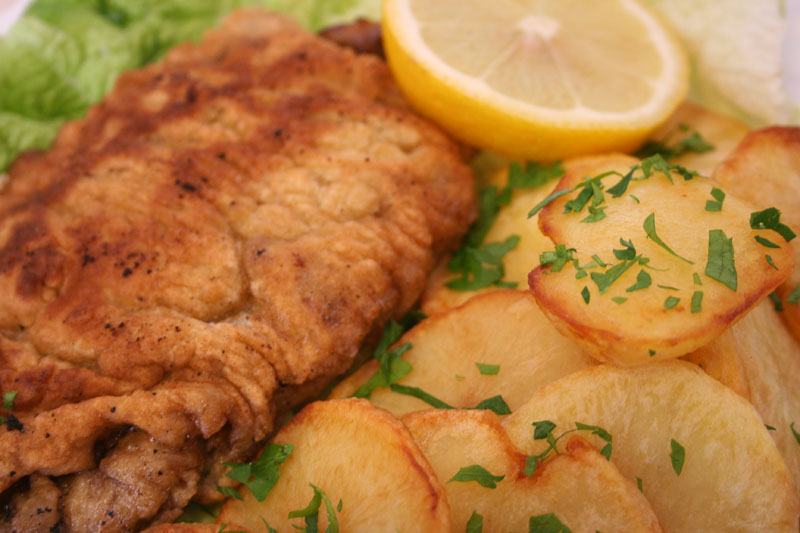
I’m not sure when the Romanians started eating schnitzel, but I would imagine that it passed overland by way of the Austro-Hungarian empire into Transylvania and gainrd popularity there. Or maybe the chefs of the more popular Bucharest restaurants recreated it for German and Austrian visitors during the early half of the last century. I have no idea to be honest and some searching on the ‘net threw up no answers. However it arrived here, it is now pretty much a staple of Romanian restaurants across the country and so here I present another version (I made a chicken schnitzel in an earlier blog post) which is cooked in a slightly different way, using a flour and egg batter rather than being dredged in breadcrumbs, a style more commonly associated with the Vienna Schnitzel (snitel vienez).

Time: 30 minutes
Servings: 2 schnitzels

Ingredients:
2 veal cutlets about 15-20mm thick
2 eggs
4 tablespoons of flour
100ml of milk*
Salt and pepper
Oil for frying (can be a mixture of oil and butter for a richer flavour)
Lemon and parsley for garnish

*I’ve seen all sorts of recipes. Some use milk, some use sour cream, some use beer, some just use less flour and nothing else. You decide.

Method:
1. Beat the eggs well and add the flour spoonful by spoonful and mix into a paste. Add the liquid (milk, cream, bread) gradually, beating constantly, until you get a batter consistency which should resemble cream. It should still be liquid but sticky enough to coat the back of a spoon.
2. Season the cutlets with salt and pepper and then, using a meat beater of some description, bash the cutlets until they are about 3mm thick and have doubled in surface area.
3. Pour about 5mm of oil (and butter if using) in a large frying pan and set on a medium-high heat. When it is up to heat, dip the cutlets into the batter, making sure they are well coated, and lay the battered cutlets in the oil (being careful not to splash oil on yourself, of course) and cook, turning once, until golden brown on both sides. The trick here is to get the temperature of the oil just right: not so hot as to burn the batter whilst leaving the meat raw, but not so cool as to make the batter soggy by the time the meat has cooked.
4. When done, remove to a plate covered with kitchen paper and leave to drain for a minute before serving.

Delicious served with potatoes of any variety (mashed, fried, sautéed, new potatoes), with a sprinkle of chopped fresh parsley, a slice of lemon, and a small bowl of ‘mujdei’ (a kind of garlic puree often served in Romania with grilled or fried meat dishes).

Saturday, 1 September 2012

Perisoare cu smantana si marar

“Meatballs with sour cream and dill”

Who doesn’t like meatballs? Well, vegetarians, I suppose. These ones are nice and juicy, especially if you can get some good lean cuts of meat and mince it up yourself. Personally I don’t like to use supermarket-bought meat, especially minced meat, which I know from people in the trade is basically just the old stuff they couldn’t sell while it still looked fresh. If you can’t be bothered to buy a meat grinder and mince it up yourself, most butchers will do it for you: that way you get the best of both worlds. I cooked them without the dried mushroom powder in the end as I didn’t have any to hand and couldn’t find it at my local market, but they were still delicious without it.

The recipe comes from Radu Anton Roman’s recipe book in the Moldavian recipe section. He recommends serving it simply with mamaliga (polenta) but as I had just made the polenta cake in the previous recipe, I had it with mashed potato instead.

Time: 90 mins
Servings: 5-6 people

Ingredients:
500g of lean veal
500g of lean pork
300g of bread, crusts removed
100ml of milk
1 medium onion, finely chopped
100g of butter
2 eggs
3 bunches of dill
Salt and pepper for seasoning
½ cup of flour
800ml of sour cream
2 tablespoons of dried mushroom powder*

Method:
1. Mince the meat and put it in a large mixing bowl.
2. Soak the bread in the milk, drain and squeeze out the excess.
3. Melt a knob of the butter in a pan and gently fry the onion until it is translucent and soft, but not burnt.
4. Beat the two eggs.
5. Finely chop the dill.
6. Mix together the minced meat, the bread, the fried onions (pour the melted butter in too), the two eggs, and one third of the dill and season with salt and pepper.
7. On a plate, mix together the flour and another third of the chopped dill.
8. With wet hands, form the meat mixture into walnut-sized balls and roll them in the flour/dill mixture to coat them all over.
9. Melt the rest of the butter in a large frying pan and, in batches if necessary, fry the meatballs until brown all over and hard.
10. Beat the sour cream with two tablespoons of the flour (use any flour that was left over from rolling the meatballs), the rest of the dill, and the dried mushroom powder*.
11. Drain any excess oil/butter off the meatballs and arrange them in a ceramic pot with a lid and pour the sour cream mixture over them.
12. Put the pot in a preheated oven on a low heat until the liquid has reduced by about half.

*I couldn’t find anything like this in the shops and have never seen it in other recipes. I suppose you could buy some dried mushrooms and blitz them up, or perhaps use a little mushroom stock cube. If anyone knows what this is exactly (praf de ciuperci uscate), please leave a comment!

Sunday, 24 June 2012

Conopida Saseasca

"Saxon-style cauliflower cheese"

The Tarnava Mare area of Transylvania is well known for its Saxon villages, some of which have gained fame through the work of Prince Charles, who frequently visits the area and helps promote agro tourism in the region. The Saxons came to Transylvania in the 12th and 13th centuries and built many of the houses and fortifications that can still be seen in the area. Nowadays few people of Saxon origin still live in the area; many left for the USA in the early 20th century, were deported by the Communists in the 1940s and 1950s, or left Romania for Germany in the 1990s. Examples of their rich culture still remain however, in artistry, architecture, and in the culinary tradition. This is a fairly typical cauliflower cheese recipe but good quality smoked pork is essential and is what gives it the real Transylvanian flavour.

Time: 60 minutes
Servings: 4 portions, maybe 6 as a side dish

Ingredients:
500g of cauliflower (about one small one)
A splash of oil
2 onions
3-4 cloves of garlic
150g of smoky pork (smoky bacon will work)
100g of grated ‘cascaval’ cheese (Chedder or Emmental as a replacement)
200ml of ‘smantana’ (sour cream)
2 eggs
Salt, pepper, and paprika for seasoning

Method:

1. Put a pan of water on the stove, add salt, start to bring to the boil. Preheat the oven to about 200C (low-medium).
2. Break the cauliflower into florettes and trim off the hard stems. Put into the boiling water, boil for 8-10 minutes, leave to drain.
3. Finely chop the onion and slice the garlic and sauté for 5 minutes in the oil on a medium-high heat until softened.
4. Chop up the bacon and add to the onion and garlic mixture and cook for another 5 minutes.
5. Add this to the now drained cauliflower and mix together.
6. In a separate bowl, mix the sour cream, eggs, and grated cheese.
7. Add the cream mixture to the cauliflower mixture and put it all in an ovenproof dish and bake in the preheated oven for about 20-25 minutes. Can be finished under the grill if you want a crispy top. Season to taste and serve.


Monday, 23 April 2012

Pulpa de porc fiarta

"Boiled thigh of pork"

I found this recipe in Teodoreanu’s book, Gastronomice the other day and wanted to give it a try. I can’t it’s a style of cooking pork that I’ve seen much in restaurants here but a couple of friends have told me that it used to be more common than it is now, being more of a home-cooked meal. It also reminds me of Sunday joints from my youth, the cold slices of meat ending up in our sandwiches for school on the Monday. I always loved the cold meat from the Sunday joint whether it be beef, lamb, pork or chicken. The pork in this recipe tasted pretty nice: reasonably moist when freshly cut with a subtle seasoning. Needless to say I had most of the rest the next day in sandwiches. I served it with a simple patience dock leaf dish and some potatoes (cartofi Munenesti) but really it could have done with a sauce. Of course, I would usually be tempted to smother it with apple sauce, but I’m not sure if that’s particularly Romanian. Do you Romanians ever have apple sauce with pork?

Time: 2 hours
Servings: 4-5

Ingredients:
1.5-2kg of pork thigh (pulpa de porc)
3-4 spring onion
2-3 fresh green garlic stems (or cloves)
Black peppercorns
Allspice
Bay leaf
Salt
Dry white wine (optional)

Method:
1. Trim off any excess fat from the pork joint, leaving, at most, a thin layer.
2. Put the joint into a deep pan and cover with water.
3. Add (roughly chopped) 3 or 4 spring onions, 2 or 3 green garlic stems (or cloves of garlic), a teaspoon of black peppercorns, a few dried allspice berries, a bay leaf, a spring or two of fresh thyme (or a level teaspoon of dried thyme), and a good few pinches of salt.
4. Cover and put on a low heat for at least an hour, possibly two.
5. As the level of liquid drops, top it up from time to time with either some more water or the dry white wine.
6. After the first hour check the meat with a fork to see if it is done. It should be soft and tender and easy to pulled bits off. If you have a meat thermometer, use that to check the internal temperature is at least 66C (150F).
7. When cooked, lift it out of the pot and rest for 5-10 minutes before carving into slices.

Thursday, 12 April 2012

Urzici cu orez la cuptor

“Nettles with rice in the oven”

So, in a previous post I cooked a dish of patience dock leaves with rice (stevie cu orez) so it only seemed fitting that I cook a similarly popular countryside dish from their archnemisis, the stinging nettle. If you’ve never eaten stinging nettles before then don’t worry as cooked nettles won’t sting. Nettles, or urzici as they are called in Romanian, start to appear in the markets around the beginning of April. In fact, there is a day dedicated to nettles called ‘nunta urzicilor’ (the wedding of the nettles) which is usually the last Sunday before Easter Sunday and is also celebrated as the Day of Flowers, when people called Florin or Florentina are wished well. After this day nettles are no longer considered good eating as their taste decreases once they have flowered, although I've obviously ignored this - we had a late winter so we are perhaps a few weeks behind schedule. However, whenever you pick your nettles, make sure you go for the young fresh tips of the plant. If you have them growing in your garden, you can continue to trim them, harvesting the new tips as they appear, for some time. If you forage them, make sure you wash them well and avoid those nettles from the roadside (probably too stinky with pollution to be edible).

In this recipe, which I found in Radu Anton Roman’s book, I’m just going to cook a simple oven dish of nettles made with rice and eggs, similar to the dish I made with the stevie (patience dock). Again, it can be a meal in its own right, or a side dish. You could serve it, as with other leaf-based dishes, with a poached or fried egg (runny yolk, of course) and even with a little bacon. As a side dish, it would probably go best with pork or beef.

Time: 90 minutes
Servings: 6 (as a main) to 8 (as a side)

Ingredients:
About 1kg (a very full carrier bag) of stinging nettles
4 eggs
50g of butter
1 glass (about 200ml) of milk
4 tablespoons of plain flour
Rice
Around 200g of telemea (white cheese, feta)
Salt and pepper

Method:
1. Pick over the nettles and remove any old leaves, rotten leaves, badly chewed leaves, wilted leaves, excessively long stalks, stalks with roots still attached – anything that doesn’t look good – and give the nettles a very good wash in cold water to remove any soil or sand.
2. Bring a large stock pot half full of water to the boil (or if you don’t have such a pot, bring two or three regular pots of water to the boil or do it in batches). Plunge the nettles into the boiling water, leave them to return to the boil, stir from time to time, and cook until well wilted and soft, probably about 5-10 minutes. Check they are done by looking for a thicker stem and tasting it – it should be soft and edible, not at all chewy, but perhaps with a little crunch. When they are done, remove them from the pan with a slotted spoon and dump into a colander over a bowl to collect the liquid. Leave for a while to drain well and steam dry. Some poeple reserve the drained liquid and drink it in the mornings on an empty stomach for health reasons - it's supposed to be a good purifier.
3. While they are boiling, wash a cup of rice and cook it in boiling water until soft.
4. While the rice is boiling, beat the eggs together in a bowl and mix in the butter (melted), the pepper, the milk, and the flour. Beat together until it’s well combined and frothy. Put to one side.
5. Once the nettles have drained and cooled a bit, chop them up roughly with a heavy knife or a mezzaluna. Probably best to do this in batches.
6. Mix the chopped nettles with the egg mixture and the cooked rice and season with salt to taste.
7. Grease a ceramic baking dish with butter or lard and tip in the nettle mixture.
8. Grate or crumble the white cheese on top.
9. Put it on the oven, preheated to a lowish heat (about 180-200C say), and leave it there for about 30 to 40 minutes, just about long enough for the egg mixture to thicken and the cheese to turn brown.

The resulting dish can be served in squares. I had it on its own with a simple salad of leurda and ceapa verde (wild garlic and spring onion) mixed together with some mayo.


Monday, 26 March 2012

Mici sau mititei

“Skinless sausages for the barbeque”

I’ve covered everything I know about mici, or mititei as they are sometimes called, in a separate article that you can read here so I’ll skip straight to the part where I tell you how I made them at home.

This was my first ever attempt at mici, or mititei, and I took the recipe from Pastorel Teodoreanu’s book on food, called ‘De Re Culinaria’. Teodoreanu’s article dates back to the 1960s and therefore the recipe probably varies from other more modern recipes in that it contains only beef. Also, as I don’t have a garden, I had to cook them under the grill. Mici, when properly cooked, take on a slightly rippled look from the barbeque, and of course, the dark lines that all genuinely barbequed meats acquire. However, I think these turned out well for a first attempt. As they started to cook, the house was filled with a smell that truly reminded me of a summer’s day barbeque, and the mici tasted quite authentic. One of the nice things about their being pure beef was that I didn’t have to cook them through. One thing I dislike about mici is that when they are made of pork you have to be more thorough in their cooking and so many time I’ve been to barbeques and been served mici which were charcoal on the outside, and dried and cardboard-y in the middle. These, although maybe a little less familiar in texture, were a little crispy on the outside, but with a nice meaty interior, with just a hint of pinkness to it.

I made a full kilogram of mici, which came to about 20 individual mici, so I was eating them for a couple of days. Many recipes suggest making them a day or two in advance and I must say that the ones I ate today (which had been in the fridge for two days) did seem to taste better than the ones I made right off the bat. It could just be that I was hungrier today, who knows?

Time: 1 hour (plus time for ‘maturing’)
Servings: 20 individual mici

Ingredients:
1 kilogram of chuck steak (ceafa de vita)
250g of beef suet (I couldn’t find this so I ended up using slanina – pork fat)*
½ teaspoon of ground cumin
½ teaspoon of ground allspice
Salt
Ground black pepper
A large chunk of bread
Some mujdei (crushed garlic, salt, and water)
½ teaspoon of bicarbonate of soda

Method:
1. Pass the beef through the mincer, then do the same with the suet. Mix them together well with your hands and then pass them through the mincer one more time.
2. Dip a lemon-sized chunk of bread (without crusts) into the mujdei and mix in with the meat.
3. Add all the other ingredients, with about a teaspoon of salt (more or less – Pastorel doesn’t give the exact quantity but I found a teaspoon was ok for my taste) and mix it thoroughly to obtain a paste.
4. Wet a wooden chopping board and your hands and roll out some of the meat paste into a smake of 3cm diameter. Cut 10-12cm lengths and place them on a moist plate. Repeat till all the meat paste is used up. Store them in the fridge for a couple of hours.
5. Cook them on a hot grill, or under a hot grill, or brush them with oil and roast them on a high temperature, or even fry them (although that tends to make them a bit too greasy).
6. Keep them warm in a cover bowl until they are all cooked and then serve with fried potatoes, fresh bread, mustard, and a salad.

*I’ve subsequently read elsewhere that the beef suet is the real ‘secret ingredient’ so I’ll have to make them again one day if I manage to find it. I wish I had been able to find the beef suet (seul de vita). Do any Romanian readers know where to get this in Bucharest?

Friday, 23 March 2012

Tocana cu rosii

“Meat stew with tomatoes”

One dish that you’ll almost certainly find a variation of on any Romanian restaurant’s menu is the tocana or tocanita. Essentially it is a stew made of meat and onions usually with other ingredients added to give it its particularity. A tocanita is simply the diminutive form of tocana. Radu Anton Roman described a tocana as a stew made from meat and/or vegetables with a lot of onions that you get in a restaurant. A tocanita, he says, is the same, but cooked by your mother.

This recipe is for a stew made with tomatoes. The key to a good tocana, I find, is slow cooking and good ingredients. Many stews in many cuisines around the world make use of lots of different stocks, spices, herbs, marinates, wines, and so on. The beauty of the Romanian tocana is its simplicity; making the most of a few choice ingredients cooked in a pot on a moderate heat with a little care over a long time. Cook it too quickly and it’s a stir fry.

Time: 60-80 minutes
Servings: 2

Ingredients:
500g of meat in large cubes (beef or pork are most commonly used – choose cuts that can stand stewing or braising like neck or belly of pork)
500g of juicy ripe tomatoes, skins removed and roughly chopped*
3-4 onions, roughly chopped
1 tablespoon of flour
Parsley or dill for garnish
Salt for seasoning
Oil or fat for cooking (any oil you like but pork dripping is traditional)

*you can use a tin of chopped tomatoes if you can find good in-season tomatoes in your local market. Out-of-season tomatoes tend to be flavourless and watery.

Method:
1. Heat a good tablespoon of the oil or fat in a deep pan and throw in the meat.
2. Add the roughly chopped onions and cook on a medium heat until the meat takes on a little colour and the onions start to soften and turn translucent. Don’t have the heat so high as to burn the onions.
3. Add a splash of water and continue to cook for about 30-40 minutes, adding water from time to time to stop it drying out and burning. Keep cooking until the onions have more or less ‘melted’ and the meat is tender and breaks apart under the pressure of the stirring spoon.
4. Add the chopped tomatoes and give it a good stir. Put a lid on it and allow to cook on a low heat for about 20 minutes, stirring occasionally and checking that it’s not burning on the bottom.
5. Sprinkle on a tablespoon of flour and mix in and leave for another 5 minutes until the sauce is rich and thick.
6. Serve with mamaliga (polenta) or your favourite type of potato (mash works well to mop up the sauces, but I was in the mood for chips). You can garnish it with any herb and add a spoonful of sour cream for extra richness if you wish.

Thursday, 8 March 2012

Gulas cu galuste

"Goulash with dumplings"

Goulash is essentially a Hungarian dish which gained popularity in the Ardeal region of Romania, eventually spreading around the entire country. There are many different recipes for goulash and every cook and every region will have their own additions or tricks. The essential componants are the meat (usually beef, but often pork), the onions, and the paprika. I was lucky enough to have some Hungarian paprika with is burnt clay colour and rich intensity. To really do the dish justice, try not to use that opened refill box of paprika that's been hiding in the back of the spice cupboard for the last six years; go out and treat yourself to a new packet. If you're interested in Romanian or Eastern European cuisine, then you're going to need it!

Although this recipe is specifically for goulash with dumplings, it's quite common to use potatoes instead. If you prefer you could make it without either, and serve it on rice or even with pasta. Whatever you do with it, it's one of those dishes that sits in your stomach and warms you from within on a cold evening. I see most of the people who visit this blog are from Romania, so leave a comment and let everyone know how you make or eat your goulash.

Servings: 4
Time: 2 hours

Ingredients:
800g of meat (shoulder of pork or beef)
3 tablespoons of dripping or oil
4-6 cloves of garlic (according to taste)
2 medium onions
2 large red peppers
1 hot pepper (optional)
1 carrot
1 tin of chopped tomatoes (or 500g of peeled and chopped fresh tomatoes if you have access to good ones)
1 tablespoon of tomato puree
4 tablespoons of good Hungarian sweet paprika (do make sure it’s not the hot kind – a mistake could be fatal!)
1 teaspoon of freshly ground cumin
2 fresh (preferably) bay leaves, torn in half or in thirds
1 bunch of parsley, chopped for garnish
Salt and pepper to season

For the dumplings:
1 egg
1-2 tablespoons of water
4-5 tablespoons of flour

Method:
1. Cut the meat into cubes of about 1.5cm square.
2. Heat/melt the dripping or oil in thick-bottomed pan and start to brown off the cubes of meat.
3. While the meat is browning off, you can prepare the vegetables. Peel and finely chop or slice the garlic. Peel the onion and chop it finely. Peel the carrot and grate it coarsely. De-seed the pepper and cut it into large pieces (2cm square-ish). If you want some kick to your goulash, chop the hot pepper, removing the seeds if you want it a little less potent.
4. Once the meat has browned off and its juices have reduced, add the onion, garlic, carrot, and pepper and cook on a medium heat until the onion has turned translucent and the pepper has softened, about 5-6 minutes.
5. Add the sweet paprika and cumin, mix in well, add the tomato puree, mix again.
6. Add the chopped tomatoes and the bay leaves and stir well.
7. Pour in about a litre of beef stock, or water at a scrape.
8. Cover and leave on a low heat for about an hour. The goulash might appear slightly too watery at this point, but don’t worry, it’ll reduce slightly over the hour and the dumplings will also absorb some of the liquid.
9. While it’s simmering, you can prepare the dumpling mix. Beat the egg in a bowl with the water and then add the flour, one tablespoon at a time, until you get a consistency that just resembles a dough rather than a batter.
10. After the goulash has had an hour with the cover on, remove the cover and taking the dough in one hand, break of smallish chunks with the other hand and roll them between your fingers to get something like a flat rugby ball, about 1cm thick. Dampening your hands with water can help. Don’t worry if they come out a little irregularly shaped, this is pretty normal for this dish. Drop these into the goulash and leave, uncovered, on the lowest heat for about 15-20 minutes. If you think it has reduced too much, you can add a drop more water or stock.
11. Serve in bowls with a sprinkle of fresh parsley and season to taste.

Jó étvágyat!

Thursday, 1 March 2012

Stiuca pane

“Pike in breadcrumbs”

Romania has a plentiful supply of freshwater fish and pike is one of my favourites. When I went to the fishmonger (I am fortunate enough to have one about 50 metres from my house) I was intending to buy some salau (/sha-lauw/ - zander in English) which is the fish most commonly served in breadcrumbs here in Romania, but alas, they had sold out. They had some frozen fillets of zander but I much prefer to buy fresh fish if I have the opportunity and so I ended up buying a pike (stiuca - /sh-tee-oo-ka/), as they had some which looked pretty fresh. See my post on trout for some advice on what to look for when buying fresh fish.

The pike is an ugly brute, full of bone, scaly, with vicious teeth, but I love the delicate white flesh. It seemed to me to be a good replacement for the zander and, although I’ve not personally seen Romanians breading pike (I haven’t even heard of them bothering to fillet it, preferring to cook it whole) I thought it would be in the spirit of ‘making the best of the freshest ingredients available to you’ so I went ahead and cooked it ‘a la salau’. I’m glad to say that the pike made a more than adequate substitute.

When buying pike, you should take into account that they are heavy-boned, thick-skinned creatures with a large head and a lot of guts. If you intend to fillet it then you should probably count on only getting about one third of its initial weight in flesh – take this into account when you buy it. I generally find that a one-kilogram pike will yield enough flesh for two people.

The pike is a boney devil with a double-rack ribcage, which is probably why people don’t often fillet it, but once you’ve done it a couple of times it’s pretty straightforward. I recommend doing a search on YouTube for pike filleting techniques as there are a few experienced North American fisherman who have posted videos showing how it’s done. At the end of the filleting process you’ll end up with two side fillets, a top fillet (which I usually cut into four ‘fingers’) and two small medallions from behind the rear fins. The side fillets are the biggest and it’s those that you can see in the photograph here. The other parts make great ‘fish fingers’ so a one-kilogram pike could well serve two adults (a side fillet each) and a kid or two (give them 2 ‘fish fingers’ and a rear medallion each).

Servings: 2 (or more)
Time: 25 minutes (including 10 minutes for filliting)

Ingredients:
1 pike of about 1kg in weight (whole) or 2 side fillets
2 eggs
200g of pesmet (fine breadcrumbs)
Plain flour
Salt and pepper
A good pinch of paprika (optional)
Cooking oil
Lemon for squeezing

Method:
1. Pour about a half a centimetre of cooking oil into a wide frying pan and put it on a medium heat.
2. Pour the breadcrumbs into a shallow dish and season with the salt, black pepper, and some paprika (if you like), the flour into another dish, and beat the eggs well in a third dish and arrange them close to the oil. Have a plate ready with some kitchen paper on it for draining the fried fish.
3. Dip the fillet into the flour and shake off any excess. Dunk it into the egg and allow the excess to drain off. Dredge it through the breadcrumbs making sure it’s well covered and gently agitate it a little so any excess falls back into the dish. Too many ‘spare’ breadcrumbs in the oil will burn, blacken subsequent fillets, and make it all taste a bit bitter.
4. Gently lay the fillet in the frying pan, which should now be hot but not spitting. Don’t put them in when it’s not hot enough as they’ll start absorbing too much oil and it’ll end up too soggy. Similarly, don’t have the heat too high or the outside will burn whilst the fish inside won’t be sufficiently cooked.
5. Fry for a couple of minutes on one side until golden brown, then carefully turn and finish off the other side.
6. Repeat with the other fillets. Depending on the size of the pan you might get them all in at once but don’t crowd them it – you should allow space for the oil to circulate and putting them all in at the same time will lower the temperature resulting in soggy fish. We want a golden crispy exterior and a cooked but tender interior. If you get it wrong, you’ll get a soggy coating and a tough overcooked fillet inside.
7. Remove the fillet to the kitchen paper to drain off any excess oil, then serve with a quarter of lemon.

Goes wonderfully with potatoes (chips, cartofi taranesti, or plain boiled), salads, or any other vegetable dish of choice, a homemade tartar sauce, or even just plain of tomato ketchup.

Saturday, 25 February 2012

Clatite Brasovene

“Brasov-style savoury pancakes”

Pancakes, or clatite, are a big part of the Romanian dining experience. Most restaurants, from the lowliest neighbourhood carciuma (a kind of bar-bistro) to the more elegant downtown restaurant will serve pancakes of some sort. Most commonly they are the sweet versions, making good use of the countries plethora of jams and preserves, but you frequently find savoury pancakes served as a starter or a main course. These savoury pancakes hail from the city of Brasov and differe from regular pancakes in that they are dipped in egg and breadcrumbs and then crisped off before serving.

They can be stuffed with whatever you like. The chicken can be omitted to make a simple vegetarian mushroom-stuffed pancake. Chicken livers can be chopped and added, as can smoke-cured meats, or even pork tenderloin. I've chosen to make them with the chicken I had left over from making supa de pui cu galuste de gris earlier, but you can use whatever you have in the fridge.

Servings: About 6-7 pancakes
Time: 50 minutes

Ingredients:

For the pancake batter:
300g of plain flour
500ml of milk
3 eggs
Salt to taste

For the crispy coating:
3 eggs
200g of breadcrumbs (pesmet)

For the filling:
1 medium onion
2 eggs
1 tablespoon of plan flour
1 glass of cold milk
1 bunch of dill
A few tarragon leaves
300g of cooked chicken chunks
600g of mushrooms
A pinch of dried thyme
Salt, pepper, and paprika, to taste
Oil (olive, butter, dripping, sunflower – whatever you prefer)

For serving:
Some kind of sauce, such as homemade tomato sauce, sour cream sauce, cheese sauce, or whatever you like.
Some chopped parsley or dill to sprinkle on top

Method:

For the filling:
1. Trim and rinse the mushrooms and perhaps cut them into thick slices (or leave whole, if they are small enough.)
2. Finely chop the onion.
3. Heat the oil in the pan and when it’s hot, add the mushrooms (and chicken pieces if they are uncooked) and onion and sauté for about 5-10 minutes until the mushrooms are cooked and the onion is translucent.
4. While they are cooking, dissolve the flour in the cold milk, add the eggs, and beat till well combined.
5. Finely chop the dill and the tarragon.
6. When the mushrooms and onions are soft, add the chicken (if you used cooked chicken), the milk/egg mixture, the thyme, pepper, salt, paprika, and mix well and leave to continue cooking on a medium-low heat for a few more minutes, until it starts to thicken up a little, then take off the heat.
7. Then stir in the chopped dill and tarragon.

For the pancakes:
1. Beat together the flour and eggs and the salt, and gradually add the milk until you get the right consistency.
2. Make the pancakes in the normal way, but they should be a little large than regular pancakes, and a little bit thicker.
3. Make all the pancakes you can with the batter and keep them warm to one side.

For the final composition:
1. Lay a pancake out in front of you.
2. Spread some of the filling on the pancake, spreading it quite thinly, from top to bottom, but not out to the sides too much.
3. Fold both sides in (fold about 2-3cm over on each side) and then roll the pancake up from the bottom to the top (thus trapping the sides you’ve just folded over to prevent the filling leaking out when you cook them).
4. Repeat until you’re out of pancakes or filling.
5. Heat some oil in a frying pan, needs to be about 1cm of oil (of whatever kind, but sunflower or dripping is most commonly used). Make sure the oil is hot, but not smoking. If it’s not hot enough, the pancakes will absorb loads of oil which makes them soggy, oily, and unpleasant.
5. Beat the eggs for the crispy coating together and pour them into a shallow dish.
6. Tip the breadcrumbs onto another plate.
7. Dip each pancake into the egg to coat it well, then roll them in the breadcrumbs until thoroughly coated, then pop them into the frying pan with the hot oil.
8. Fry them evenly all over and remove to a plate with some kitchen paper on it to drain off any excess oil.
9. Arrange them nicely on the serving plates and just before serving, drizzle on some sauce of your chose, but don’t pour on too much on the top or they’ll go soggy. Garnish with herbs and serve.

Enjoy!